The ideas, a little slower
The stairs and the review are in the pictures. Here are the ideas in words.
On page 4 Willow answers in a smooth, sure voice. A language model is trained to predict the next piece of text, so it writes what is likely given everything before it. Most of the time likely text is also true text, because most of what the model learned from was written by people trying to say true things. But likely and true are not the same, and the gap between them is where the best-known failure of chat assistants lives. Researchers call fluent output that is not supported by the facts "hallucination". Willow's "no problems before" is the story's example, a likely sentence laid over a real visit.
On page 5 the screen shows six cases that never existed. In 2023 two lawyers in New York filed a brief in a personal injury suit against an airline, and it cited court decisions that were not real. One lawyer had asked ChatGPT for supporting cases, and it had produced plausible names, case numbers and quotations. The judge found that at least six were made up. He fined the lawyers and their firm 5,000 dollars and told them to write to the real judges whose names had been used falsely. The court's main criticism was that they kept standing by the cases after doubts were raised. Professor Lin's line, "certainty is not evidence", is the lesson of that case.
On page 9 Teo explains why a model guesses. There are four causes that overlap. The training goal rewards plausibility, and the most likely ending to "The capital of a made-up country is" is a word that sounds like a city. Facts seen only once are learned poorly, and in 2025 Adam Kalai and colleagues argued that some errors on such facts are expected even when the training data has no mistakes. Most tests give a point for a right answer and nothing for "I don't know", so a model tuned to score well learns to guess, like a student on a multiple-choice test with no penalty for wrong answers. And fluency hides error, because the tone is the same whether the answer is right or wrong. Teo's "Willow isn't lying" is also a point about words. Some researchers prefer "confabulation" or "fabrication" to "hallucination", because hallucination suggests a mind seeing things, and a model has no perceptions to be mistaken about.
On page 10 Xiaoyu asks about a broken leg that never happened. A model that has never seen a fact must still produce something, and Willow's answer is the story's version of that. A real care system might answer differently, and a good one would say that it cannot find a record. The point is the pattern. Ask about something nobody ever wrote down, and a model can still answer, in the same warm voice, with something that only sounds right.
On page 14 the record from 2031 is a lesson about looking things up. Many assistants now search a collection of documents first, paste the best matches into what the model reads, and answer from them while pointing to where they came from. This is called retrieval-augmented generation, and Patrick Lewis and colleagues described it in 2020. It cuts down made-up answers but does not end them. Ziwei Ji and colleagues, in a 2023 survey, separate two kinds of error. An intrinsic one contradicts the source it was given, as a summary that changes a date. An extrinsic one adds things the source cannot confirm. Willow's summary of the 2031 visit did the second, because it added "no problems" to an eye check.
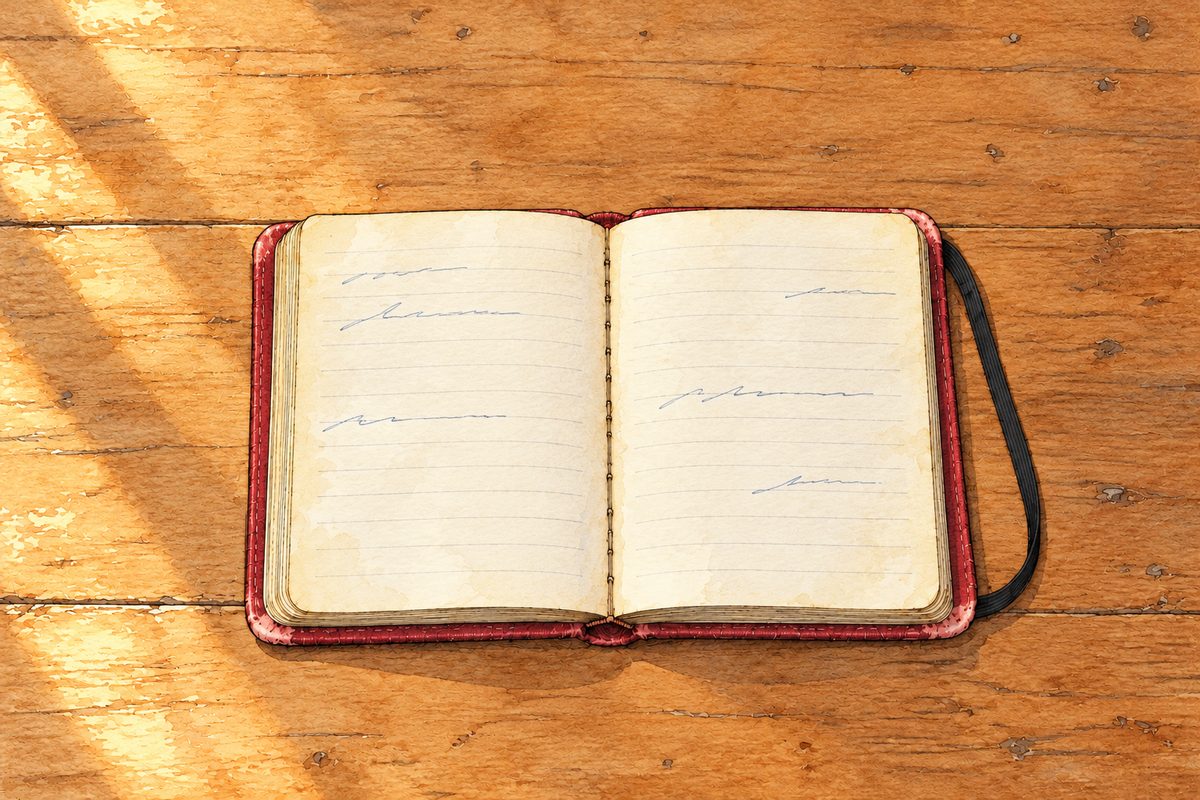
On pages 15 and 16 Grandpa's notebook beats the machine. That is not a fact from the research, it is a link to it. Willow could only read what had been put into its computer, and the paper notes from the Lotus Lane clinic never were. Before you trust a sure answer about something that matters, ask where it came from, and whether the thing that would prove it wrong was ever written where the machine could see it. Dr He asking Willow "How do you know?" is the question that works on people too.
On page 18 the mood of the whole chapter is spelled out. These tools are often very good, and their mistakes are often strange. They can be wrong while sounding sure. So check what matters, notice when a case is new or unusual, and treat a smooth answer as a draft, not a verdict. Training a model to say "I'm not sure" more often helps, at some cost in how helpful it feels. None of the fixes removes the problem entirely, as of 2026.
On page 19 Teo says he is good at finding what a model never saw. A model does best on cases like the ones it learned from, and can fail when the world shifts outside them. This is called out-of-distribution failure. In 2018 John Zech and colleagues found that a model trained to find pneumonia on chest X-rays could also tell which hospital an X-ray came from, partly from markings on the image. Because disease rates differed between hospitals, this helped it score well without learning medicine, and its accuracy dropped at a hospital it had not seen.
One last sentence for families. If an app or an AI says something about medicine that worries you, ask a doctor or a pharmacist, and never stop or change a medicine on your own. In the story Xiaoyu does not stop the pill herself. The doctor does.
What is true here
Tiny changes, big mistakes
In 2013 Christian Szegedy and colleagues found that changing each pixel of a photo by a tiny, carefully chosen amount can make a neural network confidently wrong, though a person sees no difference. In a famous example from Ian Goodfellow and colleagues in 2014, a panda labelled "panda" with about 58 percent confidence became "gibbon" with over 99 percent after a faint pattern was added. The effect reaches the real world. In 2018 Kevin Eykholt and colleagues put a few stickers on a real stop sign and made a road-sign classifier read a speed-limit sign in most test conditions, and Anish Athalye and colleagues 3D-printed a turtle that a classifier called a rifle from most angles. Language models have their own versions, which people call jailbreaks.
The wrong lesson
A learning system picks up whatever pattern most easily reduces its error. Robert Geirhos and colleagues called this shortcut learning in 2020. In 2016 Marco Ribeiro and colleagues built a classifier on purpose to tell wolves from huskies from photos where every wolf stood on snow. It learned that snow means wolf. They did it to test whether people could spot the problem. Cows photographed on a beach were not recognised as cows by a model trained on cows on grass (Beery and colleagues, 2018). Shown a cat shape filled with elephant skin, an image network tends to say "elephant", where a person says "cat" (Geirhos and colleagues, 2019). People take shortcuts too, such as a student who memorises answers, but we have ways of noticing, and a model usually does not.
Fog, frost and a four-year-old's voice
In 2019 Dan Hendrycks and Thomas Dietterich tested image classifiers under fog, blur, frost and pixelation, and found that they lose far more accuracy than people do. Everyday shifts are everywhere. A voice assistant trained mostly on adult speech may struggle with a small child. A model trained on text up to a certain date knows nothing after it. A car trained in sunshine meets snow. Dario Amodei and colleagues listed robustness to this kind of shift among five concrete problems in AI safety in 2016.
SourcesJi and colleagues (2023), Survey of hallucination in natural language generation.Mata v. Avianca, Inc. (S.D.N.Y. 2023), opinion and order on sanctions, 22 June 2023.Kalai, Nachum, Vempala and Zhang (2025), Why language models hallucinate.Lewis and colleagues (2020), Retrieval-augmented generation for knowledge-intensive NLP tasks.Zech and colleagues (2018), Variable generalization performance of a deep learning model to detect pneumonia in chest radiographs.Koh and colleagues (2021), WILDS, a benchmark of in-the-wild distribution shifts.Hendrycks and Dietterich (2019), Benchmarking neural network robustness to common corruptions and perturbations.Geirhos and colleagues (2020), Shortcut learning in deep neural networks.Geirhos and colleagues (2019), ImageNet-trained CNNs are biased towards texture.Ribeiro, Singh and Guestrin (2016), "Why should I trust you?"Beery, Van Horn and Perona (2018), Recognition in terra incognita.Szegedy and colleagues (2013), Intriguing properties of neural networks.Goodfellow, Shlens and Szegedy (2014), Explaining and harnessing adversarial examples.Eykholt and colleagues (2018), Robust physical-world attacks on deep learning visual classification.Athalye and colleagues (2018), Synthesizing robust adversarial examples.Amodei and colleagues (2016), Concrete problems in AI safety.
What is pretend
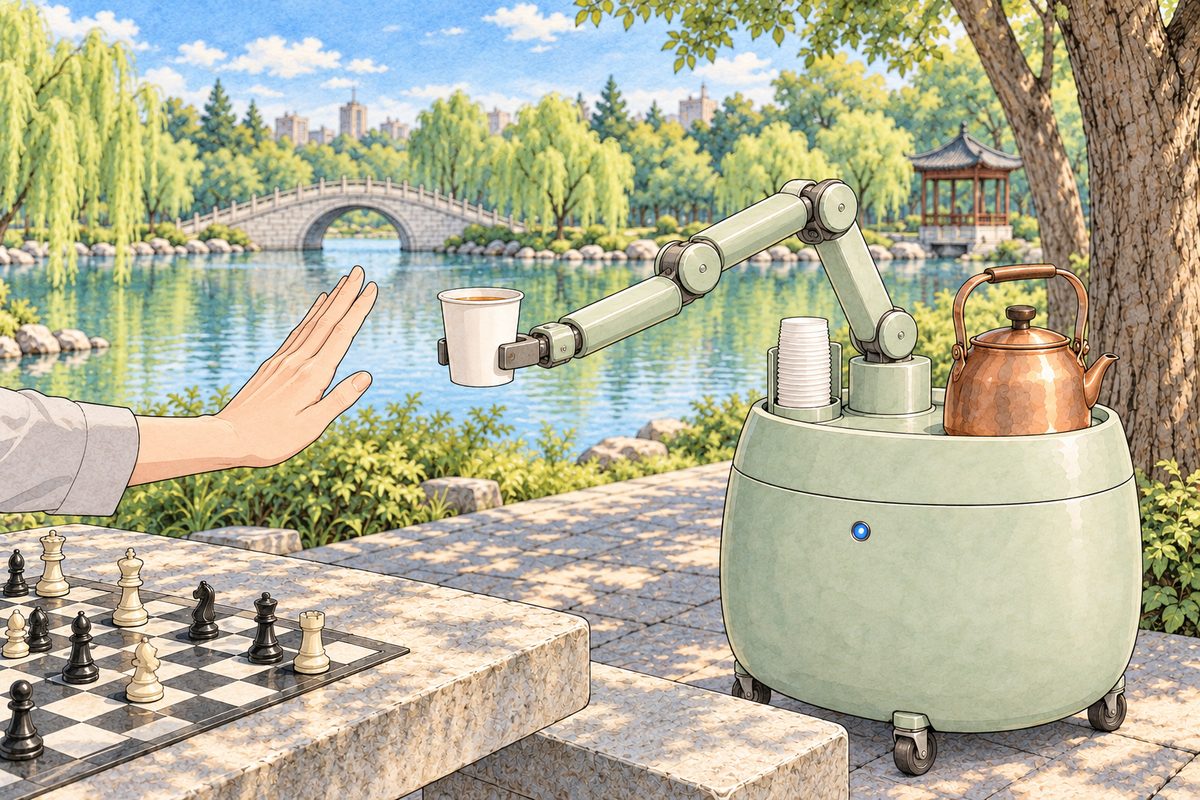
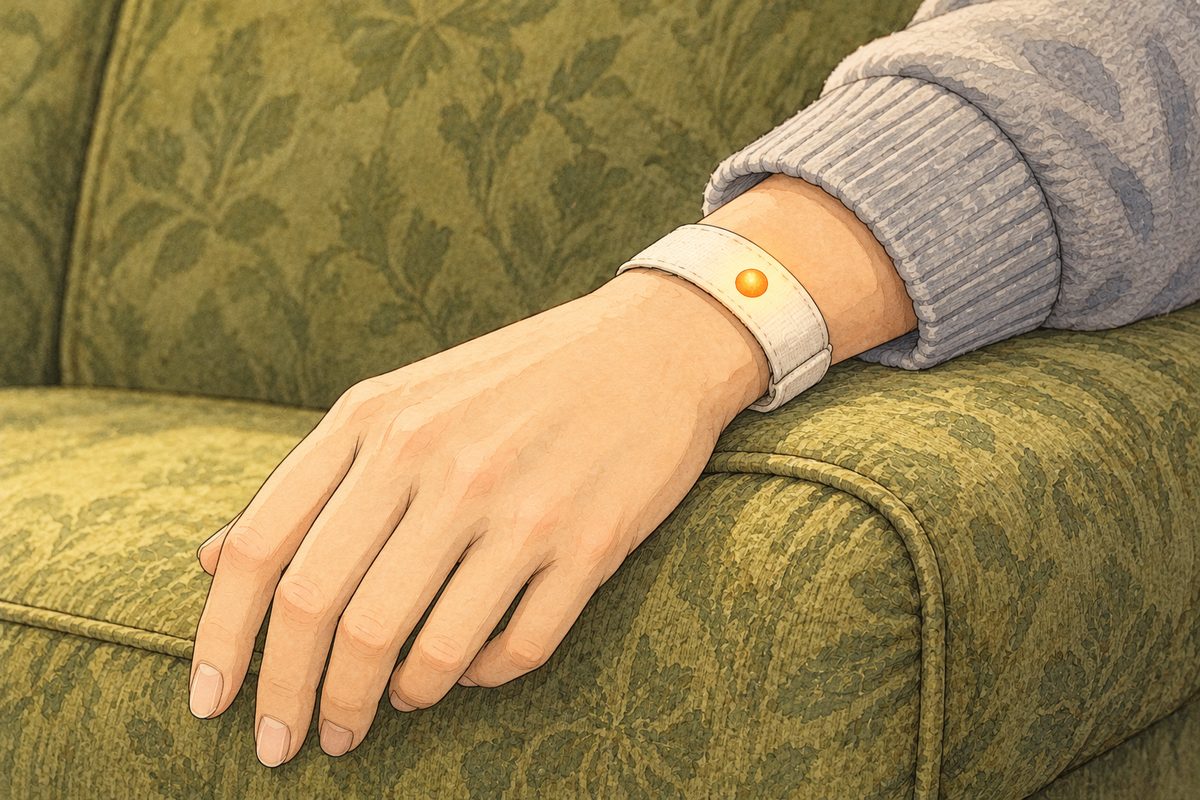
Bridge City and everyone in it are made up. So is the whole world of 2037, with its garden towers, solar boats and robot tea cart. Willow, its wristband, its pill box and every word it says are made up, and so are the city care service, Lakeview Care Home and the review. Lantern and its hundred cities are made up. The yellow and white pills are made up too, and no real medicine is meant, nor are the Lotus Lane clinic, Dr Gao, Dr Liu and the 2031 eye check. So are the broken leg that never was, Bridge City University, Professor Lin, her lab and Teo. The story is set a few years from now and imagines a hopeful future. No real care product is described, and in real life medicines are changed by doctors and pharmacists. Grandpa's memory is drawn from no one in particular, and the story makes no medical claim.
Who made this
Yingying Fu created this manga. She chose the story and its people, directed every page, and edited every word and picture. The words were drafted with Claude, an AI by Anthropic. The pictures are made with AI image generation, painted panel by panel from her direction and checked and corrected by hand.
 Chapter 1第一章What Counts as Clever什么才算聪明
 Chapter 2第二章Before the Machines机器之前
 Chapter 3第三章Rules and Habits规则和习惯
 Chapter 4第四章One Little Neuron一个小小的神经元
 Chapter 5第五章Learning from Mistakes从错误里学
 Chapter 6第六章Everything Is Numbers一切都是数字
 Chapter 7第七章Learning to See老吴
 Chapter 8第八章The Next Word下一个字
 Chapter 9第九章Attention注意力
 Chapter 10第十章The Helper助手
 Chapter 11第十一章A Voice from Tape磁带里的声音
 Chapter 12第十二章Learning by Playing边玩边学
 Chapter 13第十三章Confidently Wrong错得理直气壮Reading now正在读
 Chapter 14第十四章Not Everyone Is Heard没被听见的人
 Chapter 15第十五章Whose Voice?谁的声音?