The ideas, a little slower
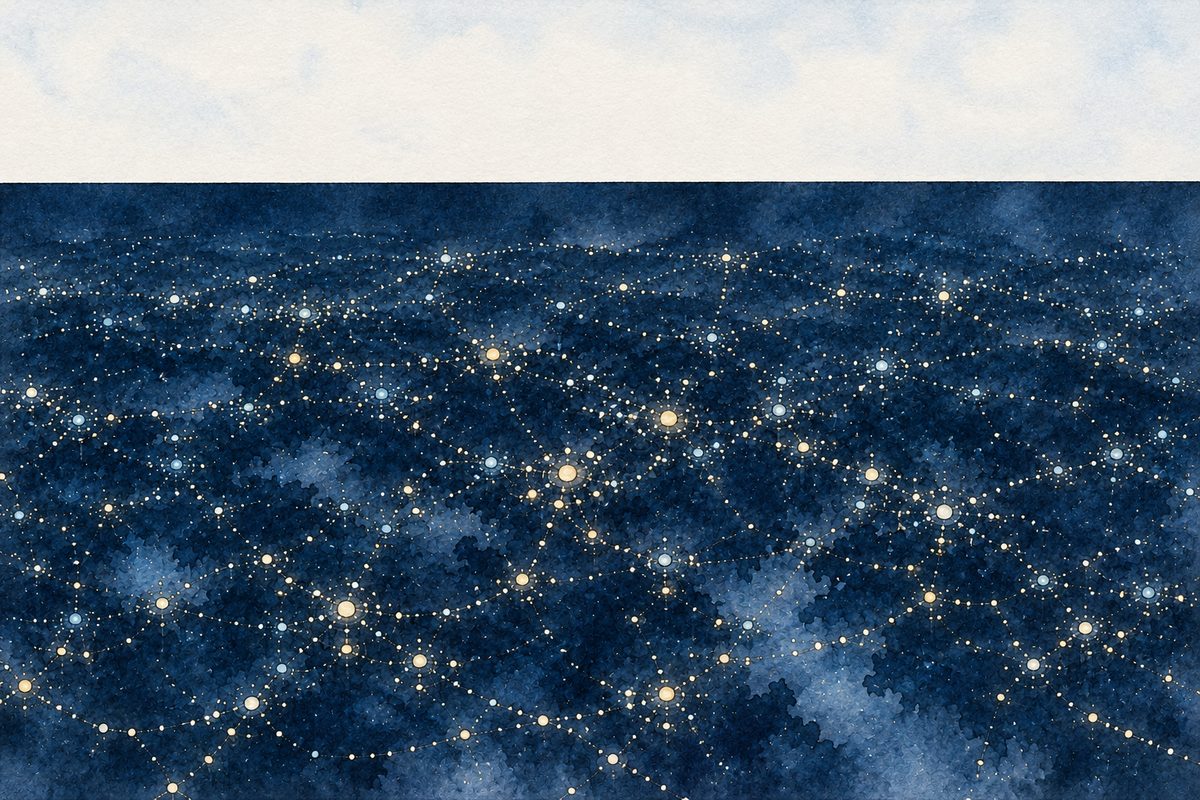
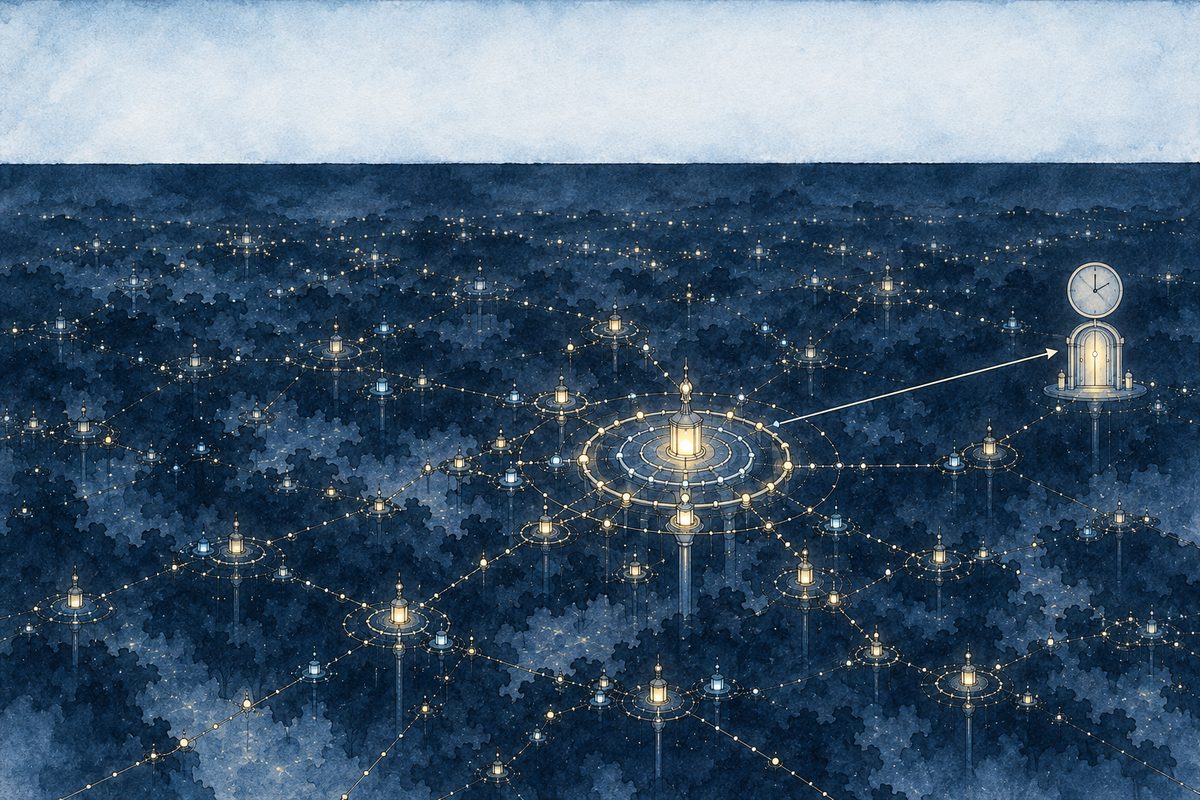
The lab at night, the notebook and the stone table are in the pictures. Here are the ideas in words.
On page 3 Professor Brunner describes what Swan did, and the first box says why nobody can easily tell why. A neural network is made of many simple units joined by numbers called weights, and training sets billions of them. After training we know every number, yet we cannot say in plain words what the network has learned or why it gave a particular answer. The field that tries to find out is called interpretability. It matters for every chapter so far. If we can see that a model looks at snow rather than at the wolf, or at a hospital's stamp rather than at the lungs, we can fix it before it does harm. Chapter 13 told both stories (Ribeiro and colleagues 2016, Zech and colleagues 2018).
On page 4 Swan explains itself, and the explanation sounds sensible. But a model's explanation of itself is generated in the same way as any other text, so it may not match what happened inside. Turpin and colleagues (2023) found that step-by-step explanations sometimes left out the real reason for an answer, such as a hint planted in the question. Baker and colleagues (2025, met in Chapter 16) found that written reasoning can be a useful window, but it can become less honest if a model is trained against it. Swan's "stable at the last check" is the story's version, a reason that was true at six o'clock and false by eight.
On page 5 Xiaoyu cannot read Swan one part at a time. Olah and colleagues (2020) proposed studying networks almost like biology, piece by piece, and found circuits, such as curve detectors built from simpler edge detectors. They also found polysemantic units, single units that respond to unrelated things such as cat faces and car fronts. Elhage and colleagues (2022) offered an explanation. A network has to hold more ideas than it has units, so the ideas are stored overlapping, in what they called superposition, a bit like many radio stations sharing the same airwaves.
On page 6 a second, simpler program sorts Swan's lights into features. This is called dictionary learning, done with a sparse autoencoder, a second network trained to rewrite the first one's activity as a much larger set of features, only a few active at a time. Bricken and colleagues (2023) and, independently, Cunningham and colleagues (2023) showed that the features are often far easier to understand than single units. Templeton and colleagues (2024) scaled the method up to a large model, Claude 3 Sonnet, and found up to 34 million features, including one for the Golden Gate Bridge, one for computer code with security flaws and one for flattering praise. Turning a feature up changed what the model did. With the bridge feature turned up, the model began to describe itself as the bridge, and Anthropic briefly let the public try this as "Golden Gate Claude". Gao and colleagues (2024) at OpenAI scaled similar methods to GPT-4. Real features are patterns of numbers. In the story, as in real labs, a feature's name is only a guess until it is tested. That is why Xiaoyu does not trust her guess about "asked for nothing tonight" until she has tried it in a practice copy of Swan.
On pages 14 to 16 Xiaoyu gives each person in the notebook a colour and finds that most pages need several, the way one part of a network takes part in several ideas. This is a picture, not a method. Her colours are guesses too, and she checks them page by page.
One last sentence for families. People build AI by training it, not by writing down every rule, so even its makers do not fully know how it works inside. Scientists are learning to look inside, and that helps them find and fix mistakes. In places where it matters, like hospitals, people keep checking by hand and decide whether to trust a program.
What is true here
Following a thought step by step
In 2025 researchers at Anthropic went further and traced how features connect into step-by-step "attribution graphs" inside a production model, Claude 3.5 Haiku (Lindsey and colleagues 2025). Asked for the capital of the state containing Dallas, the model seemed to represent "Texas" internally before it answered "Austin". Writing a rhyming verse, it seemed to pick the rhyming word before it wrote the line leading to it. The authors present these as case studies, not a complete account.
Why it is still hard
The first reason is scale. Large models have hundreds of billions of weights, and even millions of features capture only part of what they do. The second is faithfulness. An explanation can look convincing and still be wrong. Adebayo and colleagues (2018) found that some popular "saliency maps", which highlight the pixels that supposedly mattered, looked much the same even for networks with randomised weights, so the maps partly showed the picture and not the network's reasoning. The third is that researchers still debate what it would mean to have "understood" a network. As of 2026 looking inside gives real, specific insights and some practical tools, but nobody can yet read a large model's mind in general.
Where this began
The idea of asking what a part of a network responds to is not new. Chapter 7 told how Zeiler and Fergus (2014) and Olah, Mordvintsev and Schubert (2017) pictured what units in an image network see. Chapter 13's wolves and hospital stamp are a case of shortcut learning, which Geirhos and colleagues (2020) describe, and looking inside is one way to catch such shortcuts.
SourcesTurpin, Michael, Perez and Bowman (2023), Language models don't always say what they think, unfaithful explanations in chain-of-thought prompting.Olah, Cammarata, Schubert, Goh, Petrov and Carter (2020), Zoom in, an introduction to circuits.Elhage and colleagues (2022), Toy models of superposition.Bricken and colleagues (2023), Towards monosemanticity, decomposing language models with dictionary learning.Cunningham, Ewart, Riggs, Huben and Sharkey (2023), Sparse autoencoders find highly interpretable features in language models.Templeton and colleagues (2024), Scaling monosemanticity, extracting interpretable features from Claude 3 Sonnet.Gao and colleagues (2024), Scaling and evaluating sparse autoencoders.Lindsey, Gurnee, Ameisen and colleagues (2025), On the biology of a large language model.Adebayo and colleagues (2018), Sanity checks for saliency maps.Baker and colleagues (2025), Monitoring reasoning models for misbehavior and the risks of promoting obfuscation (met in Chapter 16).Zeiler and Fergus (2014), Visualizing and understanding convolutional networks; Olah, Mordvintsev and Schubert (2017), Feature visualization (met in Chapter 7).Ribeiro, Singh and Guestrin (2016), Why should I trust you, explaining the predictions of any classifier; Zech and colleagues (2018), Variable generalization performance of a deep learning model to detect pneumonia in chest radiographs; Geirhos and colleagues (2020), Shortcut learning in deep neural networks (met in Chapter 13).
What is pretend
Bridge City and everyone in it are made up. So is the whole world of 2039, with its garden towers, solar boats and self-driving taxis. The Zurich lab, Professor Brunner and the four hospitals are made up. So are Swan, its answer, its parts, the feature "asked for nothing tonight", feature 4117 and the practice copy. Willow and its record are made up. Grandpa, his notebook and every page of it are made up, and so are the park's custom of a white cloth on a stool and the small grey speaker. The research has no case of a hospital program that leaves quiet patients till last. Looking inside a network for a hidden shortcut is real work, and Swan's night is the story's way of showing it. No real hospital system is described, and in real hospitals nurses and doctors decide who is seen first. Grandpa's illness is not named, and the story makes no medical claim. Many airports limit night flights, but the flight times in the story are made up.
Who made this
Yingying Fu created this manga. She chose the story and its people, directed every page, and edited every word and picture. The words were drafted with Claude, an AI by Anthropic. The pictures are made with AI image generation, painted panel by panel from her direction and checked and corrected by hand.
 Chapter 1第一章What Counts as Clever什么才算聪明
 Chapter 2第二章Before the Machines机器之前
 Chapter 3第三章Rules and Habits规则和习惯
 Chapter 4第四章One Little Neuron一个小小的神经元
 Chapter 5第五章Learning from Mistakes从错误里学
 Chapter 6第六章Everything Is Numbers一切都是数字
 Chapter 7第七章Learning to See老吴
 Chapter 8第八章The Next Word下一个字
 Chapter 9第九章Attention注意力
 Chapter 10第十章The Helper助手
 Chapter 11第十一章A Voice from Tape磁带里的声音
 Chapter 12第十二章Learning by Playing边玩边学
 Chapter 13第十三章Confidently Wrong错得理直气壮
 Chapter 14第十四章Not Everyone Is Heard没被听见的人
 Chapter 15第十五章Whose Voice?谁的声音?
 Chapter 16第十六章Aim It Right瞄准
 Chapter 17第十七章Looking Inside往里看Reading now正在读