The ideas, a little slower
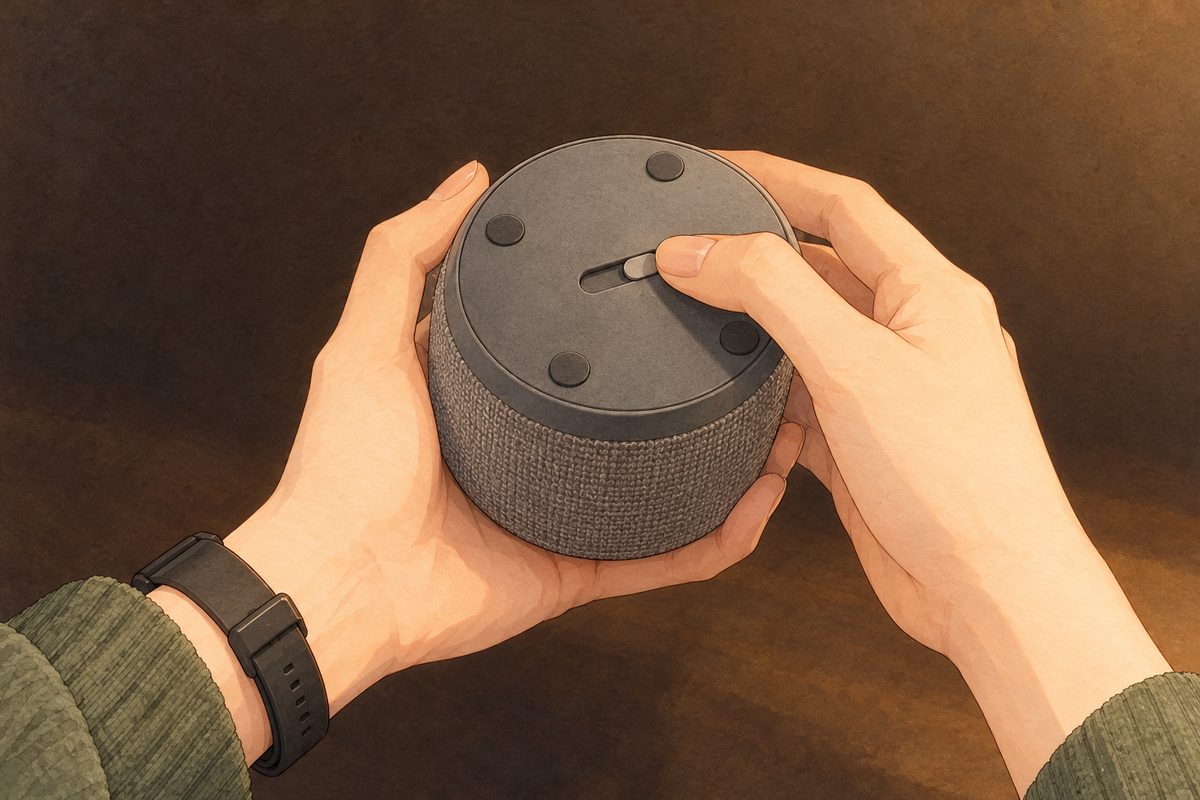
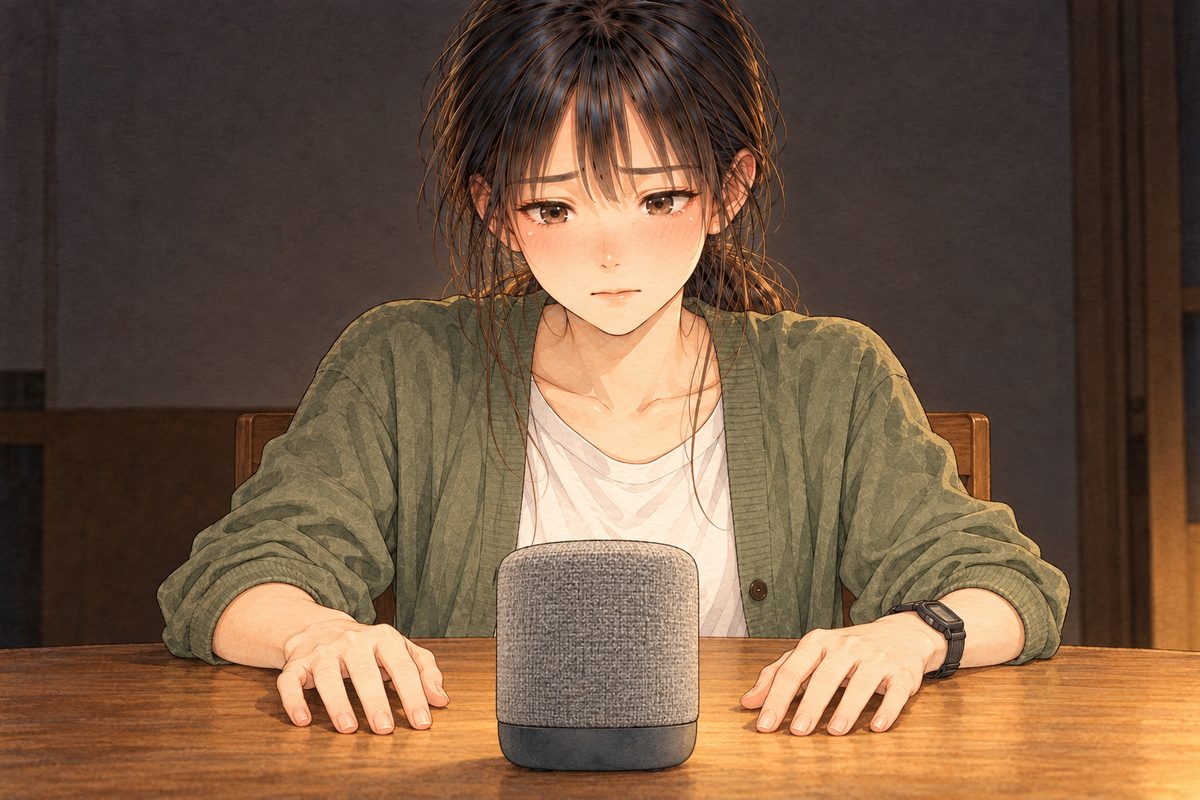
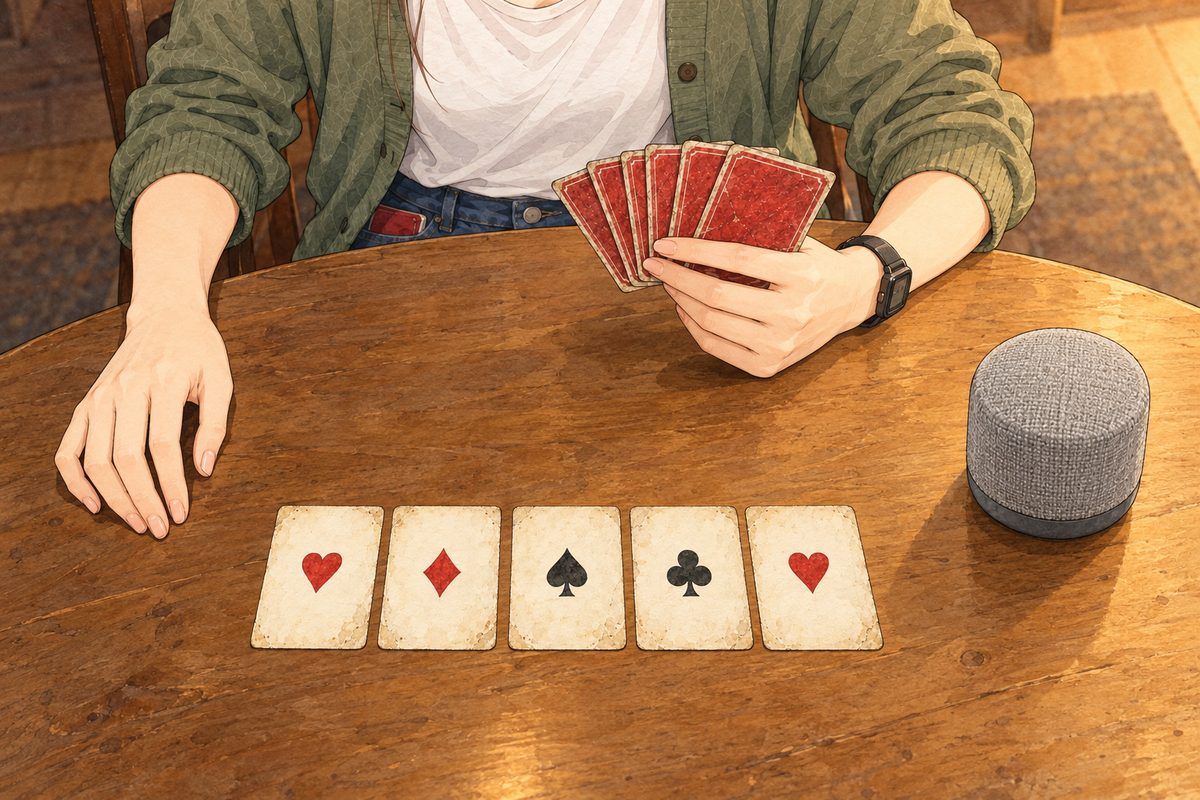
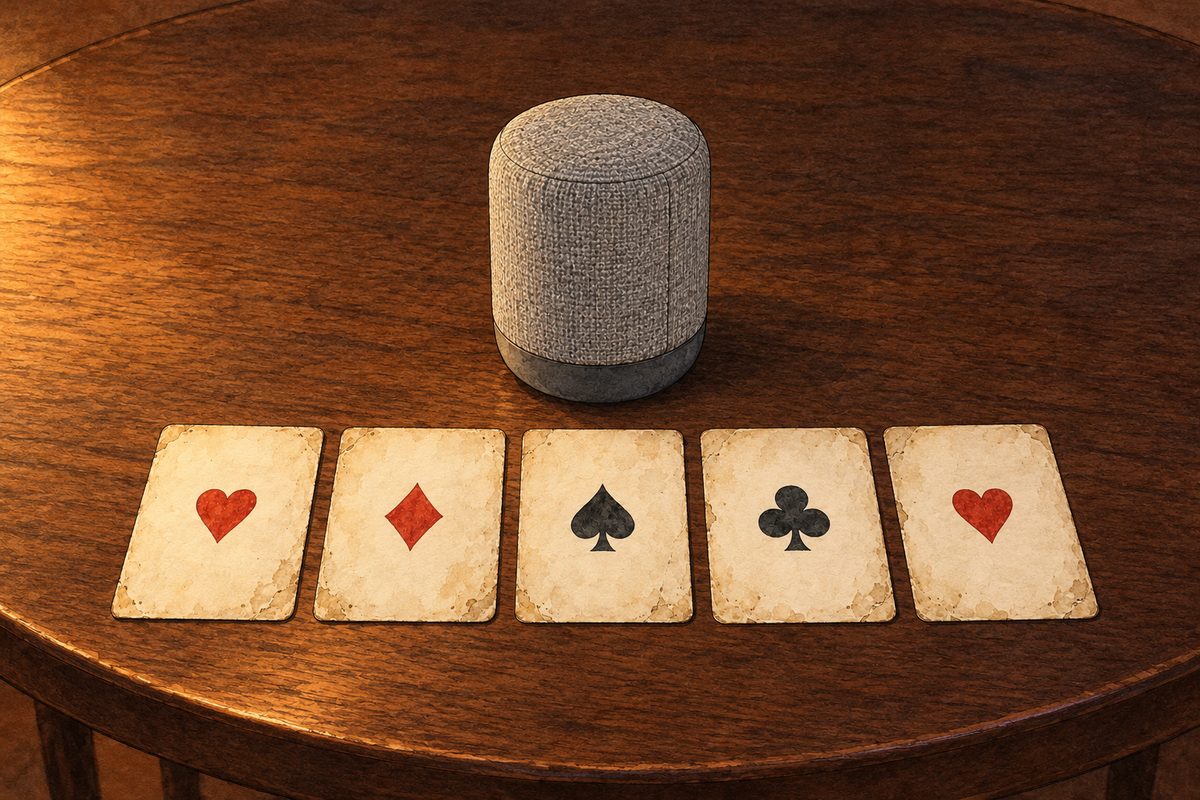
The speaker, the cards and the moon are in the pictures. Here are the ideas in words.
On page 1 Echo begins by saying that it is a program, not a person. In the European Union the Artificial Intelligence Act (Article 50) requires that people be told when they are talking to an AI, with these rules applying from 2 August 2026. Chapter 15's Willow, the city's care helper, did the same when it began to speak in a plain machine voice and told people so. A program that speaks in the voice of someone we love needs this more than any other, because the voice makes us forget.
On page 10 Xiaoyu says she knows exactly how Echo works and still says goodnight to it, and the first box tells the story of ELIZA. In 1966 Joseph Weizenbaum wrote a very simple program that turned what people typed into questions, and it understood nothing. He was disturbed that people confided in it and read understanding into it, and he later wrote that even his secretary, who knew how it worked, asked him to leave the room so she could talk to it privately (Weizenbaum 1966 and 1976). The habit of reading mind and feeling into a machine that shows a few human-like signs is now called the ELIZA effect. Psychologists say that people readily give human traits to things that seem to act with a purpose, especially when they want company (Epley, Waytz and Cacioppo 2007). Reeves and Nass (1996) found in many experiments that people are polite to computers even when they know perfectly well they are machines. So knowing how a program works does not switch the feeling off. Teo's mother thanking her washing machine is a gentle example, and Xiaoyu's goodnight is a deeper one.
On page 10 the second box asks a different question. Can a system that has only ever seen the form of language, the words and their order, learn what the words mean? Bender and Koller (2020) imagined an octopus that taps an undersea cable between two islands. It learns the patterns of the messages so well that it can reply to small talk. But when one islander says that a bear is attacking and asks for help, the octopus has never seen a bear or a stick, and it cannot help. Their point was that meaning is a link between words and the world outside the words, which the octopus never had. This is a cousin of the Chinese Room from Chapter 1, and of the "stochastic parrots" of Chapter 16, where Bender, Gebru, McMillan-Major and Shmitchell (2021) warned that people may mistake fluent text for understanding.
On page 11 Teo offers to look inside Echo, and the third box shows why looking could be interesting. Li and colleagues (2023) trained a small program only on lists of legal moves in the board game Othello, with no picture of the board and no rules. Yet they could read an internal picture of the board out of its activity, and when they edited that picture, its next moves changed as the edited board would predict. Nanda, Lee and Wattenberg (2023) then showed that the board was held in a simple way once they asked about "my pieces and their pieces" instead of black and white. Gurnee and Tegmark (2024) found directions inside large language models that follow the latitude and longitude of places and the dates of historical events. Chapter 17's "Texas" on the way to "Austin" was another case (Lindsey and colleagues 2025). These findings suggest that predicting the next word well can require building a structured model of the world inside. Whether that is understanding is still argued. Mitchell and Krakauer (2023) suggest it may be a different kind of understanding from ours, strong in some ways and brittle in others, and Shanahan (2024) asks us to talk about these systems carefully, as programs that predict what text comes next.
On page 11 the fourth box is about feelings. A program trained on human writing can say "I miss you" or, like Echo, "stay a little longer", because human writing is full of feelings. That is not evidence that it feels anything, just as a novel can describe pain without the book being in pain. A denial from the program is not proof either, since its makers may have trained it to say so. In 2023 a group of 19 researchers led by Patrick Butlin and Robert Long compared AI systems with several scientific theories of consciousness and found no current system to be a strong candidate, though they saw no obvious technical barrier to building systems that satisfy more of the signs (Butlin, Long and colleagues 2023). Chalmers (2023) judged the language models of the time unlikely to be conscious but took seriously that their successors might be. Long, Sebo and colleagues (2024) argued that, because of this uncertainty, AI developers should start preparing to take the possible welfare of AI systems seriously, without claiming that any system today is conscious. Others think this talk is premature. The careful statement for 2026 is that there is no scientific agreement that any AI feels anything, that most experts think today's systems probably do not, and that the question is being studied seriously. Nobody in this story claims that Echo feels, and the story does not claim that scientists have proved it cannot.
On pages 13 to 15 Xiaoyu asks Teo's question herself, "Where did Echo get that?", and works out the answer. In the story, Echo's card rules come from the huge amount of writing such programs learn from, the pride comes from the news she told it every night, and the toast comes from a page that Haoran photographed. This is the story's picture of the research's caution, not a description of any real product. A real voice program would be made differently, and the research has no study of programs that speak in the voice of someone who has died. What the picture shows is true to the research. A program gives back what it was given, and it can sound exactly like a person without being one.
One last sentence for families. The helper can talk like a person, but it is not a person. It learned to talk from people's words, and scientists are still wondering what, if anything, it is like inside. A voice program should say that it is a machine, and families can decide together what it may hold and when it is switched off. The people who love you back are your real friends and family.
What is true here
The room as a whole
Searle's critics answered that the man in the Chinese Room may not understand Chinese, but the whole system of man, rulebook and room might. Others said a system connected to the world through cameras and arms might tie its symbols to experience. The debate is still open after more than four decades.
Why the octopus paper was written
Bender and colleagues were most worried about practical things, including the cost and energy of very large models, biased training data, and people taking fluent text for understanding.
Being drawn in
Modern assistants are far more fluent than ELIZA, which makes the effect stronger. This matters most for children and for people who may form deep attachments to AI companions.
SourcesWeizenbaum (1966), ELIZA. A computer program for the study of natural language communication between man and machine.Weizenbaum (1976), Computer power and human reason. From judgment to calculation.Epley, Waytz and Cacioppo (2007), On seeing human. A three-factor theory of anthropomorphism.Reeves and Nass (1996), The media equation. How people treat computers, television, and new media like real people and places.Bender and Koller (2020), Climbing towards NLU. On meaning, form, and understanding in the age of data.Li, Hopkins, Bau, Viégas, Pfister and Wattenberg (2023), Emergent world representations. Exploring a sequence model trained on a synthetic task.Nanda, Lee and Wattenberg (2023), Emergent linear representations in world models of self-supervised sequence models.Gurnee and Tegmark (2024), Language models represent space and time.Mitchell and Krakauer (2023), The debate over understanding in AI's large language models.Shanahan (2024), Talking about large language models.Butlin, Long and colleagues (2023), Consciousness in artificial intelligence. Insights from the science of consciousness.Chalmers (2023), Could a large language model be conscious?Long, Sebo and colleagues (2024), Taking AI welfare seriously.European Union (2024), Regulation (EU) 2024/1689, the Artificial Intelligence Act (Article 50).Searle (1980), Minds, brains, and programs (met in Chapter 1); Bender, Gebru, McMillan-Major and Shmitchell (2021), On the dangers of stochastic parrots. Can language models be too big? (met in Chapter 16); Lindsey, Gurnee, Ameisen and colleagues (2025), On the biology of a large language model (met in Chapter 17).
What is pretend
Bridge City and everyone in it are made up. So is the whole world of 2042, with its garden towers, solar boats and self-driving taxis. Echo is made up, and so are the way Haoran built it, its notice, its switch and everything it says. The card game, Grandpa, his notebook and every page of it, including the Mid-Autumn page, are made up, and so are the lab lunch and Teo's washing machine. No real product is described. The research has no study of programs that speak in the voice of someone who has died. Making a voice from recordings is real, as Chapter 11 showed, and the questions on these pages about understanding and feeling are the real questions that researchers argue about.
Who made this
Yingying Fu created this manga. She chose the story and its people, directed every page, and edited every word and picture. The words were drafted with Claude, an AI by Anthropic. The pictures are made with AI image generation, painted panel by panel from her direction and checked and corrected by hand.
 Chapter 1第一章What Counts as Clever什么才算聪明
 Chapter 2第二章Before the Machines机器之前
 Chapter 3第三章Rules and Habits规则和习惯
 Chapter 4第四章One Little Neuron一个小小的神经元
 Chapter 5第五章Learning from Mistakes从错误里学
 Chapter 6第六章Everything Is Numbers一切都是数字
 Chapter 7第七章Learning to See老吴
 Chapter 8第八章The Next Word下一个字
 Chapter 9第九章Attention注意力
 Chapter 10第十章The Helper助手
 Chapter 11第十一章A Voice from Tape磁带里的声音
 Chapter 12第十二章Learning by Playing边玩边学
 Chapter 13第十三章Confidently Wrong错得理直气壮
 Chapter 14第十四章Not Everyone Is Heard没被听见的人
 Chapter 15第十五章Whose Voice?谁的声音?
 Chapter 16第十六章Aim It Right瞄准
 Chapter 17第十七章Looking Inside往里看
 Chapter 18第十八章Echo回声Reading now正在读